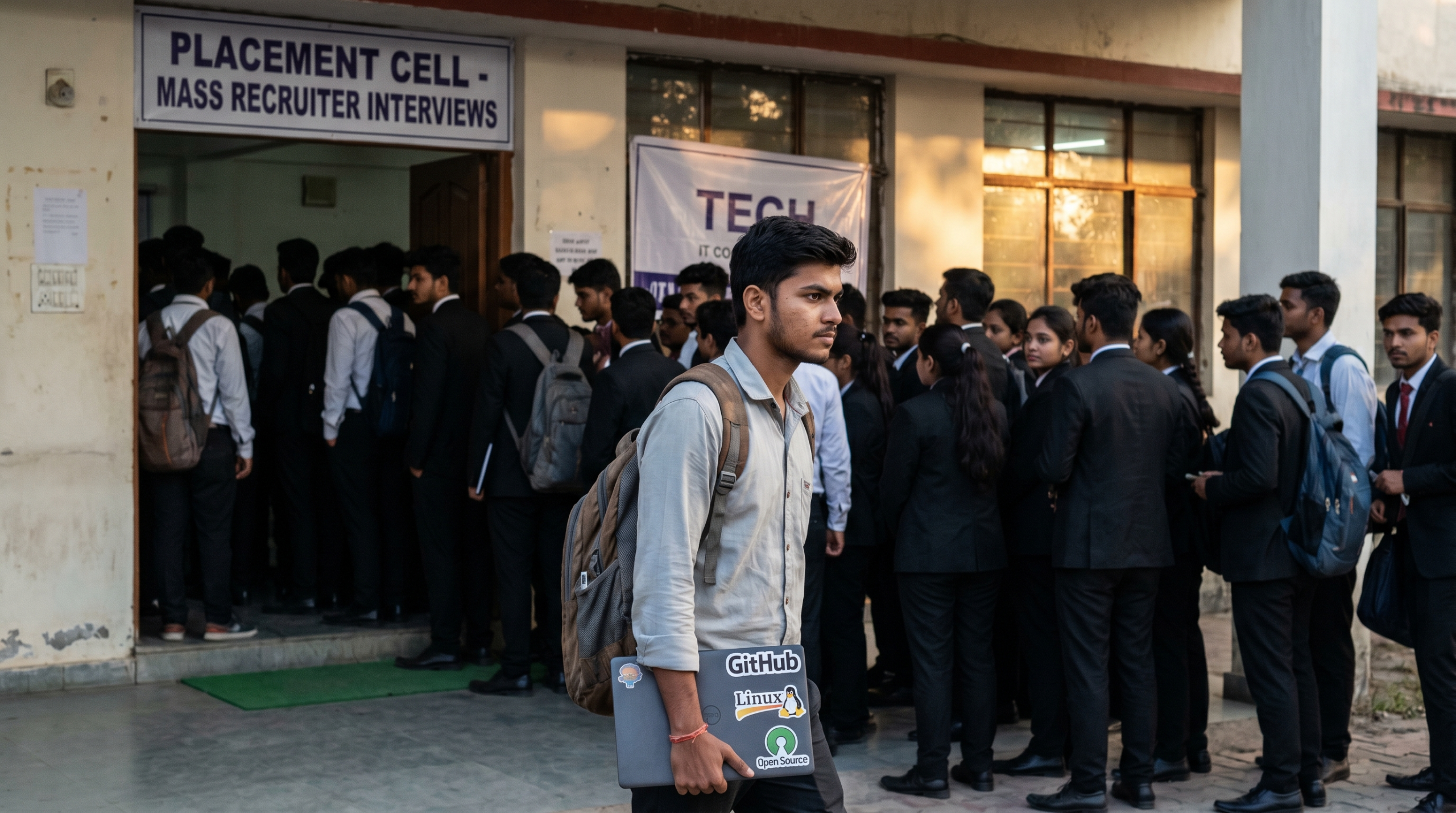
How to Get a 10+ LPA Job as a Fresher From a Tier-3 College
Let me start with a confession.
I’m tired of the LinkedIn posts that go: “From a tier-3 college to 32 LPA at Google! Here’s my secret 🚀”, and then the secret is “consistency” and a Notion template. That’s not advice. That’s a humble brag with a free download.
This post is the opposite of that.
If you’re at a tier-3 college in India right now, refreshing the placement WhatsApp group every 20 minutes hoping a new “drive” pops up, this is for you. The actual 10+ LPA path is not glamorous, not fast, and not for everyone. But it’s also not gatekept the way people pretend it is. The ceiling is real, but it’s nowhere near as low as your placement cell makes it feel.
Let me walk you through what actually works in 2026.
Who this is for
CSE / IT / ECE / BCA / MCA students from a tier-2 or tier-3 college, anywhere in India, who:
- Aren’t going to crack GATE or do an MS abroad
- Have a placement cell that maxes out at 4–6 LPA service company offers
- Are willing to put in 12–18 months of focused, unsexy work
If you want a “30 days to FAANG” guide, close this tab. Genuinely. I’d rather you not read this than read it and be disappointed.
The brutal reality check (read this twice)
Before we get into tactics, you need to internalise three things. If you don’t, no roadmap will save you.
1. The college tag matters less than it used to, but it’s not zero
In 2020, tier-3 to 10 LPA was a freak event. In 2026, it’s uncommon but not rare. According to a Rehearsal AI analysis of 50+ Reddit success stories, candidates from tier-3 colleges are now landing roles at PhonePe, Amazon, Google, and Microsoft regularly. But almost always off-campus, almost always after 6–18 months of focused effort, and almost always with a portfolio that does the heavy lifting the degree won’t.
The thing that’s changed: companies have started caring more about what you can do than where you came from, partly because they got burned hiring tier-1 grads who couldn’t write a clean for-loop without ChatGPT, and partly because GitHub made it trivial to verify skill.
If you want a quick gut-check on where you currently stand, run your resume through a tool like the Let’s Code Job Ready Score. It scores your resume, LinkedIn and GitHub on a 100-point scale and gives you a 90-day action plan. A useful baseline before you start.
2. Your placement cell is not your friend
I’m going to be unkind here. Most tier-3 placement cells are designed to optimise for “100% placement” stats, not for your salary. That’s why they invite TCS Ninja and Infosys SP and call it a “great drive.” A 3.6 LPA offer counts as a placement on their report. It does not count as a life.
Once you accept this, that the people whose actual job is to place you are systemically incentivised to underplace you, you stop waiting for them and start running your own race. This is the single biggest mental shift.
3. 10 LPA is a floor, not a ceiling
Here’s something nobody told me when I was 19: ₹10 LPA from a tier-3 college as a fresher used to be a flex. In 2026, it’s the bare minimum a competent CS grad with real skills should be aiming for. People are pulling 18, 24, even 33 LPA from tier-3 colleges. The PhonePe 33 LPA story (the candidate from a slum who solved 800+ LeetCode problems) is documented and verified, not folklore.
So when I say “10+ LPA” in the title, I mean it as the entry point to a different category of job, not the destination.
The math: where 10 LPA actually comes from
Let’s de-mystify the salary structure first, because half the panic comes from not understanding what you’re chasing.
A “10 LPA” fresher offer in India in 2026 typically breaks down as:
- Fixed CTC: ₹7–8.5 LPA (this is what hits your bank monthly, after tax, roughly ₹55–65K/month in-hand)
- Variable / performance bonus: ₹1–1.5 LPA
- Joining bonus: ₹50K–2 LPA one-time
- Stocks / RSUs: 0–1.5 LPA/year (only at product companies)
- Other benefits: insurance, gratuity, gym, food. Adds up to ₹50K–1L on paper
The roles that actually pay this for a fresher fall into a small number of buckets:
Product-based MNCs: ₹14–28 LPA
Examples: Microsoft, Adobe, Amazon, Atlassian, Salesforce, Goldman Sachs
Tough but doable off-campus. Heavy DSA + system design fundamentals. For company-specific prep, Let’s Code maintains PYQ banks for a lot of these. Google, Goldman Sachs, Adobe, Amazon and Meta are all worth a look.
Indian product unicorns: ₹10–24 LPA
Examples: PhonePe, Razorpay, Zomato, Swiggy, CRED, Groww, Meesho
Most realistic target. Care about projects + DSA roughly equally.
GCCs (Global Capability Centers): ₹8–18 LPA
Examples: Walmart Labs, JP Morgan, Wells Fargo, Target, Lowe’s, Optum, Morgan Stanley
Underrated. Hire in bulk, pay well, work-life balance is real.
AI-first / VC-backed startups: ₹10–22 LPA + equity
Examples: Sarvam, Krutrim, Setu, Chargebee, early-stage YC startups
Highest variance. Equity could be life-changing or zero.
Remote roles (US/EU companies): $15–50/hour or ₹15–40 LPA equivalent
Examples: Crossover, Toptal, Turing, direct cold outreach
Hardest to break into. Pays the most. No campus pipeline at all.
Notice what’s not on this list: TCS, Infosys, Wipro, Cognizant, Accenture, Capgemini. Those service companies hire in bulk, but they top out at 3.5–7 LPA for freshers, and the 7 LPA “Digital” tier is actively gatekept. If your endgame is 10+ LPA, service companies are a stepping stone at best, and increasingly, not even that. As Cambridge Infotech’s 2026 salary report lays out, freshers without a top-tier degree but with real skills are bypassing service-company purgatory entirely. (If service companies are still a fallback for you, the TCS PYQ set on Let’s Code is the most efficient way to clear their OA.)
The 12-month playbook (what to actually do)
Okay. Theory done. Let’s build a plan.
This assumes you’re in your 5th or 6th semester right now and want a 10+ LPA offer by graduation. If you’re a 1st or 2nd year, you have more time, which is a luxury. Use it. If you’re already in your final year and haven’t started, this is harder but not impossible. You’ll just have to compress everything and accept that you might need a 6-month gap year of grinding post-graduation.
Months 1–4. Foundations: pick a stack, learn DSA seriously, build one good project. Focus: Stop dabbling. Commit.
Months 5–8. Depth: 250+ LeetCode problems, 2 deployed projects, internship/freelance. Focus: You should look hireable on paper now.
Months 9–12. Distribution: referrals, applications, mock interviews, offers. Focus: Convert the work into actual offers.
Phase 1 (Months 1–4): Build the foundation, stop dabbling
The number one reason tier-3 grads stay at 4 LPA isn’t lack of intelligence. It’s that they spent 3 years half-learning ten things instead of fully learning two.
Pick a primary stack and stick to it. I don’t care which one. The valid options for 2026 are roughly:
- Full-stack web (MERN / Next.js + Node + Postgres): most jobs, most tutorials, easiest to build portfolio projects
- Backend + cloud (Java/Go + AWS or Python/FastAPI + Docker/K8s): slightly fewer junior openings, but higher pay
- AI/ML engineering (Python + PyTorch + LangChain/LLM APIs): highest pay ceiling, highest skill bar, hardest to fake
Per the Cambridge Infotech 2026 fresher salary breakdown, Agentic AI Developers and ML Engineers command the highest fresher offers (₹8–16 LPA range), full-stack and cloud sit in the ₹5–10 LPA band, and cybersecurity sits a bit below. AI pays the most but is the least forgiving of fakery.
My honest recommendation: if you’re starting now, do full-stack web first, because the iteration speed is faster. You can ship a real project in two weeks. Then you can pivot into AI/ML or DevOps in months 6+. Don’t start with AI/ML unless you’ve already done some Python and basic ML. Too many people get stuck in tutorial purgatory.
If you want a ready-made path for any of these stacks, Let’s Code publishes free roadmaps for DSA, System Design and DevOps that are tuned for Indian placements. A sane starting point if roadmap.sh feels too generic.
DSA: the part everyone gets wrong
Here’s the most overrated and underrated piece of advice in Indian tech: DSA matters. It’s overrated because it doesn’t matter for every job. It’s underrated because for the jobs that pay 10+ LPA, it’s the single biggest filter.
But here’s where everyone screws up: they grind 1000 random LeetCode problems and still bomb interviews. The data we have on this is now pretty clear. From the TamilTech 2026 interview prep guide: you don’t need 1000 problems. You need 150–200 problems covering 15–20 core patterns, deeply understood.
The patterns that matter (memorise this list):
- Two pointers / sliding window
- Hashing / frequency counting
- Binary search (and its variants: search in rotated array, search on answer)
- Stack / monotonic stack
- Linked list manipulation
- Trees: traversals, BST properties, LCA
- Heaps / priority queue
- Backtracking
- Graphs: BFS, DFS, topological sort, union-find
- Dynamic programming (1D, 2D, knapsack, LIS, edit distance)
- Greedy
- Bit manipulation
- Tries
- Intervals / sweep line
- Recursion + memoization
The realistic LeetCode count by goal:
- Service company / 6–8 LPA: ~80 problems, mostly easy + medium
- Indian product unicorn / 12–18 LPA: ~200 problems, heavy on mediums
- FAANG / 20+ LPA: 400–800 problems, including at least 100 hards
The PhonePe-from-slum story I mentioned? 800+ problems. The Amazon SDE-1 from a tier-3 college? 1,300 problems including 300 hards, with a Codeforces rating above 2,000 (source). These aren’t suggestions. They’re the actual receipts.
If you want some structured pressure on top of self-study, the Let’s Code 100 Days DSA Challenge is a free contest series where you compete with other students daily. Free is free, and the social accountability is the actual product.
The pattern beats the count
Solving 500 problems by reading the editorial after 5 minutes is worse than solving 150 by sitting with each one for 45 minutes until you genuinely understand the trick. I’d rather hire someone who’s solved 100 problems three times than someone who’s solved 500 once. The interview is testing pattern recognition under pressure, not memory of solutions.
Resources I actually recommend (in order of how I’d use them):
Striver’s A2Z DSA Course (takeUforward) (DSA, primary) Free, structured, in Indian-English, covers everything from arrays to advanced DP. The single best free resource for Indian students. Start here.
NeetCode 150 / NeetCode 250 (DSA, pattern recognition) The 150 problems most frequently asked at FAANG, grouped by pattern. Watch his explanation videos. They’re gold.
LeetCode itself (DSA, practice) Use the company tags. If you’re targeting Microsoft, filter by “Microsoft, last 6 months”. The problems repeat more than companies want to admit.
Let’s Code Company PYQs (DSA, company-specific) Curated previous-year coding questions for TCS, Wipro, Infosys, Amazon, Microsoft, Goldman Sachs, Meta, Adobe and more. Once you’ve picked a target list of companies, work through their PYQs in the last 4 weeks before applications open. The question style tends to repeat year-on-year.
roadmap.sh DSA Roadmap (DSA, reference) Visual roadmap for what to learn in what order. Good for sanity-checking that you haven’t missed a topic.
Codeforces (for the ambitious) (DSA, advanced) If you want to go beyond LeetCode and into competitive programming, this is where the people who crack FAANG actually train. Aim for 1500+ rating before applying to top companies.
Building your first real project
Not a to-do list. Not a calculator. Not a Netflix clone you followed a 4-hour YouTube tutorial to build.
A real project, by the 2026 hiring-manager definition, has these properties:
- It solves a problem that a real person (you, ideally) actually has
- It’s deployed and live at a URL you can paste into a resume
- The README is good: problem statement, tech choices, screenshots, “what I’d build next”
- The commit history shows progress over weeks, not “Initial commit. Final version.”
- You can talk about technical decisions for 15 minutes without notes
The DEV community piece on portfolio projects that get you hired in 2026 puts it bluntly: a portfolio of tutorial clones is worse than no portfolio. It signals that you can follow instructions but can’t think.
Some project ideas that work well in 2026 (steal these):
- A study companion that uses an LLM to generate quizzes from your PDF notes. Touches AI, file handling, auth, deployment.
- A small SaaS that tracks your subscriptions and warns you 7 days before renewal. Payments, cron jobs, email APIs, real-world utility.
- A clone of a feature you find broken in a tool you actually use, then write a blog post about how you’d fix it.
- A CLI tool you’d actually use, uploaded to npm or PyPI with downloads.
- An open-source contribution to a library you depend on, even if it’s just docs or a small bug fix.
If you’re staring at a blank page, the Let’s Code Final Year Project ideas list is a decent prompt. Most students pick something off it and customise rather than inventing from scratch. The ideas are also calibrated for what hiring managers actually find interesting (i.e., not another library management system).
The GitHub portfolio guide for freshers is right that 3–4 good projects beat 15 mediocre ones. Quality is so much more legible than quantity.
Phase 2 (Months 5–8): Get hireable on paper
By the end of month 8, when someone scrolls your LinkedIn and GitHub, they should see:
- 150+ LeetCode problems solved (visible on your profile)
- 2–3 deployed projects with live links and clean READMEs
- 1 internship or freelance gig, paid, ideally
- A LinkedIn that doesn’t look like everyone else’s
- A resume that fits on one page and uses metrics
Let me dig into the parts that get fumbled most.
The internship piece
Yashraj, who wrote about going from 4 LPA to 10+ LPA from a tier-3 college back in 2023, made one point that’s aged really well: prioritise paid internships over unpaid ones, even if the paid one pays less than your monthly chai budget.
Why? Two reasons:
- In Indian tech, salary slips matter. When you’re negotiating your first job, “I was getting ₹15K/month at this startup as a JS intern” is a leverage point. “I was an unpaid intern at this NGO doing tech” is not.
- A paid offer signals that someone, a real adult with P&L responsibility, looked at your work and decided it was worth money. Unpaid internships signal that you’d accept anything.
Where to find paid internships in 2026:
- Internshala: still the largest aggregator in India, decent quality if you filter for “stipend > 10000”
- Wellfound (formerly AngelList): early-stage startups, often willing to take risks on tier-3 students
- LinkedIn: set alerts for “intern” + your stack, apply within hours of posting
- Let’s Code Jobs: daily job alerts on WhatsApp, Telegram and LinkedIn with direct apply links, filtered for Indian freshers
- Cold-emailing founders. Counterintuitively, this is the highest hit-rate method for tier-3 students. More on this below.
Building your resume and LinkedIn: the part everyone fakes
LinkedIn for tier-3 placements is a strange beast. Most people either ignore it entirely or go full influencer mode posting “🚀 Excited to share that I have completed a 5-day workshop on HTML 🚀” which is somehow worse.
What actually works in 2026:
- Headline: “[Your stack] developer | [What you’ve built]”. Example: “Full-stack developer building Indic-language AI tools | Next.js + FastAPI”
- About: 3 short paragraphs covering what you build, what you’re learning, what you’re looking for. No emojis. No “passionate about technology and innovation.”
- Featured: pin 2 projects with screenshots
- Posts: 1–2 per month max, about something you actually built or learned. Skip the motivational posts. Recruiters scroll past those.
- Connections: aggressively connect with engineers (not just recruiters) at companies you want to work at. Comment thoughtfully on their posts before sending the connect request.
For the resume itself, the bar in 2026 is brutal because every application gets ATS-screened first. If you don’t have a senior to review yours, run it through the Let’s Code AI Resume Studio. It scores against ATS, suggests rewrites, and lets you export a clean PDF. Free, and it surfaces the dumb keyword gaps that get you auto-rejected. For LinkedIn specifically, the LinkedIn Optimizer does the same for your headline, summary and skills.
Per the 2026 off-campus strategy guide on College Simplified, referrals increase your interview chances by ~5x compared to cold applications, and cold-applying as your only strategy has dropped to under 2% success rate in 2026 because every resume now goes through an AI screen first. The takeaway: you cannot afford to skip the human-network part.
Phase 3 (Months 9–12): Convert the work into offers
This is where it stops being about “skill-building” and starts being about distribution. You can be the best engineer in your college and still get zero offers if nobody’s looking at your application.
The referral game (the most important section in this entire post)
I want you to internalise this: a referral is the difference between your resume going through an AI bot screen and going directly to a recruiter’s inbox. It is not a small advantage. It is the entire game for off-campus placements at top companies.
Here’s the playbook that works in 2026:
Step 1: Identify the right person. Not the recruiter. Not the senior VP. A mid-level engineer (SDE-2 or SDE-3) at the company, ideally on a team that’s actually hiring. Find them on LinkedIn by searching “[Company] software engineer” and filtering by “people who studied at [your state’s universities]”. Alumni connections work disproportionately well.
Step 2: Don’t ask for a referral on the first message. This is where 95% of people blow it. Your first message should be ~3 lines, no asks, just curiosity:
Hey [Name], I saw you work on [specific team/product] at [Company]. I’m a final-year CS student building [your project] and I’ve been looking at how [Company] solves [related problem]. Would love to read anything you’ve written about it if you have a blog or talk?
That’s it. No resume. No referral ask. You’re a human being with curiosity, not a resume in a trenchcoat.
Step 3: Wait for a reply. If you get one, have a normal conversation. Ask one or two genuine technical questions. Mention a project you’ve built. After the second or third exchange, then, only then, you say:
Btw, I noticed [Company] has an opening for [role] on the [team] team. Would you be open to referring me if my profile is a fit? Happy to send over a tailored resume + a 2-line note on why I think I’d add value.
Hit rate on this approach when done right: 30–40%. Hit rate on “Hi sir please refer me to your company” cold pings: under 2%.
Step 4: Send a “referral kit”, not a resume dump. The 2026 standard is:
- Job ID and exact role
- Your one-page resume (PDF)
- 2-line pitch on why you’re a fit
- Links to your top 2 projects
Make it a 30-second decision for them to forward.
Cold email, yes, really
Cold emailing founders and engineering managers is underrated and works disproportionately well for tier-3 students because nobody else is doing it. Here’s the template that’s gotten me and others responses:
Subject: [Specific thing about their company] — quick question

Hi [Name],

I've been following [Company] since [specific moment, a launch, a tweet,
a podcast]. I'm a final-year CS student and I built [project] which uses
[similar stack/idea to what they do].

I'm not looking for an interview right now. I'd love 10 minutes of your
time to ask 2 questions about how you think about [specific technical
problem]. Happy to do this async over email if a call doesn't work.

Resume + project link below in case it's useful context, but really just
the questions for now.

Thanks for considering,
[Your name]
[Resume link, GitHub, project link]
The reason this works: you’re not asking for a job, so they have no reason to say no. Once you have a conversation, opportunities surface naturally.
If you want more variants for different scenarios (referral asks, follow-ups, post-interview thank-yous), the Let’s Code cold email templates collection has a solid set you can adapt. Don’t copy verbatim though. Recruiters can spot a template at 50 paces.
Where to find off-campus drives (the actually-good list)
The aggregator landscape changes constantly. As of April 2026, these are the ones worth checking weekly:
- Wellfound: startups, including ones hiring outside India
- Instahyre: Indian product companies, decent fresher filter
- Cutshort: high-growth Indian tech roles
- LinkedIn Jobs: the default; set alerts with the “Past 24 hours” filter
- Naukri: still the largest in India by volume
- Let’s Code Startup Directory: curated startup jobs across Bangalore, Hyderabad, Pune and remote, with separate filters for unicorns and product companies
- Let’s Code AI Job Finder: upload your resume and it scores live job postings against your profile with a fit percentage; useful for cutting through the noise of generic boards
- Company career pages directly: Microsoft Careers, Amazon University, Google Careers, Adobe, etc.
Programs specifically designed for “non-tier-1” candidates that most students don’t know about:
- Amazon University Talent Acquisition (AUTA): Amazon’s program to hire from colleges they don’t visit. Apply directly on the Amazon careers page in your final year.
- Microsoft Engage: Microsoft’s program for sophomore CS students; if you’re in your 2nd or 3rd year, this is a huge lever.
- Google STEP / Summer of Code: for sophomores. Open globally.
- Goldman Sachs Engineering Campus Hiring: they actively hire off-campus from tier-2/3 colleges.
The interview process (briefly)
Once you start getting interviews, the typical 2026 funnel for a 10+ LPA fresher role looks like:
- Online assessment / OA (90 min, 2–4 coding problems)
- Tech screen (1 hour with an engineer, 1–2 problems + some fundamentals)
- Onsite / virtual onsite (3–5 rounds: 2 DSA, 1 system design lite, 1 behavioural, sometimes 1 project deep-dive)
- HR / fit round
- Offer + negotiation
Before you walk into a real interview, do at least 5–10 mock interviews. The single biggest “I should have done this earlier” regret of every fresher I know. The Let’s Code AI mock interview tool covers 35+ topics including DSA, CS fundamentals and aptitude. Free and unlimited. Pair that with reading actual interview experiences from people who interviewed at your target companies. It’s a much better calibration than generic Glassdoor data.
A few things that 80% of tier-3 candidates fluff:
- Project deep-dive rounds. Interviewers will ask, “Why did you pick Postgres over MongoDB for this?” and if you say “because the tutorial used it,” you’re done. Have a real reason for every technical choice in your projects.
- Behavioural rounds. Use the STAR format (Situation, Task, Action, Result) and prepare 5–6 stories that you can adapt to any prompt. “Tell me about a time you disagreed with a teammate” comes up in basically every interview.
- Negotiation. Almost all freshers, especially tier-3 ones, accept the first offer out of relief. Don’t. You can almost always negotiate 10–20% on the fixed component just by saying “I’m currently interviewing with two other companies, would you have flexibility on the base?”, even if the “two other companies” are, uh, aspirational. Just don’t lie outright.
For CS fundamentals interview questions (OOPs, JavaScript, DBMS, OS, SQL, the stuff that comes up in every screening round), the Let’s Code interview question banks are categorised by topic and worth a once-through the week before any interview.
The mental game: what nobody warns you about
Here’s the part of the post that won’t show up in any other “10 LPA from tier-3” listicle.
The loneliness is real
Most of your classmates are not going to be doing this with you. They’ll be playing BGMI, watching IPL, going to fests, and eventually, accepting 4 LPA TCS offers. You will sometimes feel like a freak for spending Sunday afternoon reviewing graph algorithms.
This is normal and it’s also the entire point. You’re optimising for an outcome 12 months out; they’re optimising for the next weekend. You won’t become friends with the people who already have what you want unless you do the boring work first.
What helps: find your tribe online. Discord servers, Twitter (developer Twitter is alive and well in 2026), r/developersIndia, r/cscareerquestionsIN, and the Let’s Code Discord communities (DSA Masters, Full Stack Hub, AI/ML Engineers, etc.) which are split by interest. Lurk first, post second. The internet will find you peers your college can’t.
Imposter syndrome will hit, and it’s not a sign you’re wrong
Around month 4 or 5, you’ll Google “[concept] explained” for the 50th time and think I am too dumb for this; the IIT kids must just get it instantly. They don’t. Almost nobody does. The difference is that they grew up around other people doing it, so the cognitive load felt normal. You’re absorbing both the material and the feeling that “people like me don’t do this.” Both are real. Both pass.
The “I’ll start tomorrow” trap
The single biggest predictor of who makes it from tier-3 to 10+ LPA isn’t IQ, isn’t luck, isn’t whether their dad knows someone. It’s whether they touch the work every day for at least 90 days in a row.
Not 8 hours a day. Not even 4. Just every day, 1–2 hours minimum, no zero days. The compounding is real and it’s almost mystical at month 6. You’ll suddenly be reading code you couldn’t have read three months ago, and you won’t even remember when the change happened.
Set a calendar reminder. Tell one person. Whatever it takes. The plan doesn’t matter if the execution doesn’t happen.
A short list of resources I keep going back to
I’ve linked things throughout the post, but here are the ones I’d actually recommend without reservation:
- Striver’s A2Z DSA Sheet: the most efficient free DSA path for Indian students
- NeetCode: pattern-based LeetCode prep, free explanations
- Let’s Code A-to-Z Placement Kit: single-page index of cold email templates, resume guides, FYP ideas, PYQs and roadmaps; the most useful “one bookmark” for Indian placements
- Let’s Code Job Ready Score: free 100-point audit of your resume, LinkedIn and GitHub with a 90-day plan
- Let’s Code Company PYQs: last-mile prep for specific company OAs
- roadmap.sh: visual roadmaps for every tech stack
- Tech Interview Handbook: open-source interview prep, especially the behavioural section
- freeCodeCamp’s full-stack curriculum: if you’re starting from scratch with web dev
- Frontend Masters: paid but worth it if you’re going full-stack (they have student discounts)
- r/developersIndia: the most honest community for Indian dev career questions
For YouTube channels specifically:
- takeUforward (Striver): DSA in Hindi/English
- CodeHelp by Babbar: DSA, very beginner-friendly
- Hitesh Choudhary / Chai aur Code: full-stack, project-based
- Apna College: placement prep, decent for absolute beginners
- Kunal Kushwaha: DSA + open source
The TL;DR (because you’re going to skim anyway)
If I had to compress this entire post into 8 lines:
- The college tag matters less than it used to. Your portfolio matters more than ever.
- Pick one stack. Commit for 12 months. Don’t dabble.
- 150–200 well-understood LeetCode problems > 800 half-solved ones.
- Build 2–3 real projects (deployed, with READMEs you’d be proud to show your future kids).
- Get a paid internship. Even ₹10K/month. The salary slip is the leverage.
- Off-campus is the path. Cold-applying without referrals is a 2% game.
- Build a referral network before you need it. Be a curious human, not a resume in a DM.
- The single biggest predictor of success is consistency over 6+ months. There is no hack.
10 LPA from a tier-3 college in 2026 is achievable. It’s not a shortcut. But it’s also not the closed door your placement cell makes it feel like.
Touch the work today. Touch it tomorrow. Six months from now you’ll be a different person.
Good luck out there.
Got something to add?
This post is a living document. If you’ve cracked a 10+ LPA offer from a tier-3 college and there’s something I missed (or got wrong), I genuinely want to hear from you. The Indian tech community is collectively undervalued because we don’t share our playbooks honestly. Be one of the people who does.
If this helped, share it with one junior in your college who needs to read it more than they need another motivational reel.
Join the channel for more updates – WhatsApp channel
Lets Code
Contributing Writer